Alpacca Silver:
Sometimes called Nickel Silver or German
Silver, the usual formulation is 60% copper, 20% nickel and 20% zinc.
This technique of metal working was practiced by the Chinese for two
millennia, and called “Paktong.” In an attempt to imitate
the Chinese alloy, “Neusilber” or New Silver was developed
by a German scientist in the early 19th century, and later marketed
under the trade name “Alpacca” Silver.
Alpaca Silver polishes to a bright silver finish
and makes stunning jewelry. Many Fair Trade artisans in Central and
South America work with Alpaca Silver material, as it is more durable
and easier to work with than silver. It is also less precious than
silver, making it a more affordable material for both the artisans
and collectors.
Annealing:
The heat treating (softening) of metal after it has been
work-hardened with steel tools, and is necessary between raising and
forging stages. Annealing is also used to remove tension in a piece
of metal before brazing, helping to reduce warpage.
Argentium
Sterling: A new firestain-free alloy with fantastic
tarnish resistance. It contains a higher percentage of fine silver
(93%, and the higher 97% fine silver). It can be stamped sterling.
More on Argentium can be found here.
Argyle:
In the 18th Century, the argyle (also spelled ‘argyle’) was
famously named after, and crafted in honour of, the fifth Duke of
Argyll, John Campbell and his wife, Elizabeth Gunning, Baroness
Hamilton of Hameldon. Throughout winter, the Duke lamented the fact
that his gravy was served freezing cold due to the extended distance
between the kitchen and the dining table. So, in order to prevent
this, the argyle was created.
Evolution of the Argyle
The earliest
prototypes had an internal compartment that could be heated up with
an iron rod which kept the contents warm.
Gradually,
different shapes, styles, and sizes of argyles were crafted. There
were a few different adaptations, and; with each alteration, the
heating system improved. Gradually, the argyle changed from the
aforementioned rod technique to an internal double-walled chamber
that could be filled with hot water.
Hot Water Compartment
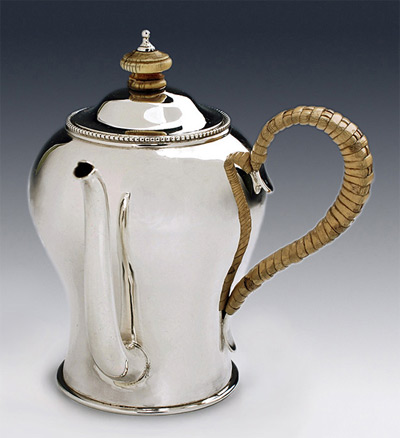
Argyles are made
in a variety of shapes and sizes, but typically most have a rounded,
curved body, and a small foot to the bottom. Typically, the spout is
placed close to the bottom of the argyle; this allowed the gravy
served to be drawn from underneath the layer of fat that settled on top.
Argyll History
Perhaps it’s
because of the shape, but many people bought argyles with the
assumption that they were tea or coffee pots and attempted to use
them for that purpose. One person described the argyle as a
‘curious little water warmed coffee pot’ (Clark, 1926).
However, later
they began to be sold as individual coffee pots. The argyle’s
dual usage makes it quite a practical piece of silverware.
Courtesy AC Silver.
Assay:
It is impractical for a refiner to refine each individual shipment
of scrap separately. To keep the operation efficient, a sample is
taken of each refining shipment to determine its precious metal
content. Drilling samples are taken from each end of the bullion. The
assay laboratory does a miniature refining process on the two samples
to determine the precious content. The bullion karat is actually
determined by the percentage of fine gold left following the assaying
process. For example, 2-100 milligram samples are taken. The samples
are wrapped in lead, placed onto cupels and put into a special assay
furnace. As the samples become molten, the base metals, including the
lead, vaporize or absorb into the cupels, leaving only the precious
metal on top. The precious metal buttons are dissolved in the acid so
that the gold content can be determined. The remaining samples are
reweighed. If the 100 milligram samples now weigh only 50 milligrams,
this means that there is 50% fine gold in the bullion.
Blistering:
This occurs when a base metal or precious metal object that is
plated with fine silver is overheated, detaching itself from the
underlying metal resulting in a surface like the below (notice the
fine blistered texture covering the chasing).
Bodkin:
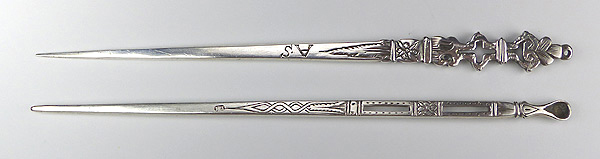
These skewers were used in the 17th century to thread
bands of yarn and ribbon through all types of clothing including
corsets. The yarn was threaded through the rectangular slits. They
could also make holes in leather as well as being utilized as a
needle. They were usually hung on a belt using the small eye.
Bodkins were personal, often carried on the person, and passed
through the generations. The small hollow at the non-tapered end of
the lower bodkin was used to scoop wax from the ear; this was used to
coat and strengthen the fibers of the thread making it easier to
insert through the eyelet. The bodkins pictured below are 5.75" long.
Bobeche: An
accessory that goes around a candle to capture wax from ruynning
down the candle holder, candlestick, or candelabra. Silver bobeches
generally sit inside a candle cup. Hear the pronunciation here.
Brass:
An
alloy consisting primarily of copper, usually with zic as the
additional metal.
Brazing:
A joining
process whereby a filler metal or alloy is heated to melting
temperature above 800 °F and distributed between two or more
close-fitting parts by capillary action. At its liquid temperature,
the molten filler metal and flux interacts with a thin layer of the
base metal, cooling to form a strong, sealed joint. By definition the
melting temperature of the braze alloy is lower (sometimes
substantially) than the melting temperature of the materials being
joined. The brazed joint becomes a sandwich of different layers, each
metallurgically linked to the adjacent layers.
When brazing
sterling, care must be used to prevent firescale or firestain which
is formed at higher temperatures than soldering.
Breakfast
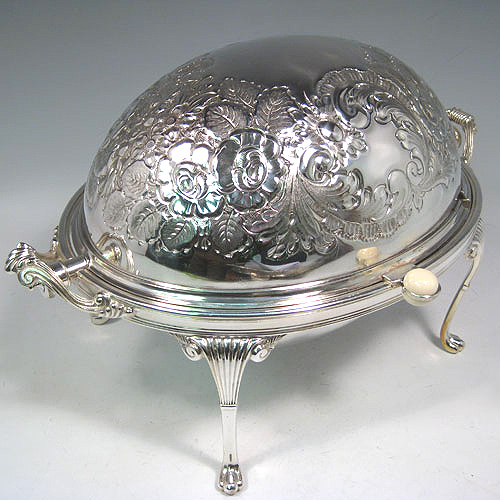
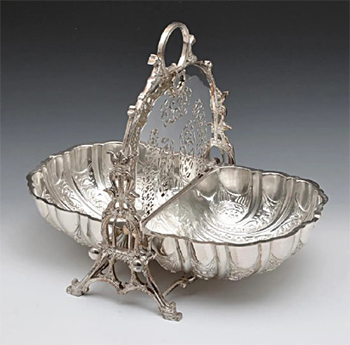
Dish: Below is a roll-top breakfast dish. The interior
has a pierced plate that the food is placed on, with hot water
beneith to keep the food warm. Normally placed on a side board.
Bright-cutting:
A form of engraving which uses polished gravers to produce very
reflective cuts.
Britannia
Silver: An alloy of silver containing 95.84% silver, with
the balance usually copper. This standard was introduced in England
by Act of Parliament in 1697 to replace sterling silver as the
obligatory standard for items of "wrought plate." The lion
passant gardant hallmark denoting sterling was replaced with "the
figure of a woman commonly called Britannia," and the leopard's
head mark of the Worshipful Company of Goldsmiths replaced with a
"lion's head erased."
Britannia standard
silver was introduced by the English government as part of the great
recoinage scheme of William III from 1696, when attempts were made to
limit the clipping and melting of sterling silver coinage. It was
thought that by maintaining a higher standard for plate, there would
be less incentive to put the newly issued sterling coins in the
melting pot.
Sterling silver
was approved again for use by silversmiths from 1 June 1720, and
thereafter Britannia silver has remained an optional standard for
silver assay in the United Kingdom and Ireland. Since the hallmarking
changes of 1 January 1999, Britannia silver has been denoted by the
millesimal fineness hallmark 958, with the symbol of Britannia being
applied optionally.
The silver bullion
coins of the Royal Mint issued since 1998, known as
"Britannias" for their reverse image, are minted in
Britannia standard silver.
Britannia silver
should be distinguished from Britannia metal, a pewter-like alloy
containing no silver.
Bronze:
An alloy consisting primarily of copper, usually with tin as the
additional metal.
Casting:
A manufacturing process by which a liquid material is (usually)
poured into a mold, which contains a hollow cavity of the desired
shape, and then allowed to solidify. The solid casting is then
ejected or broken out to complete the process. Casting is most often
used for making complex shapes that would be otherwise difficult or
uneconomical to make by other methods.
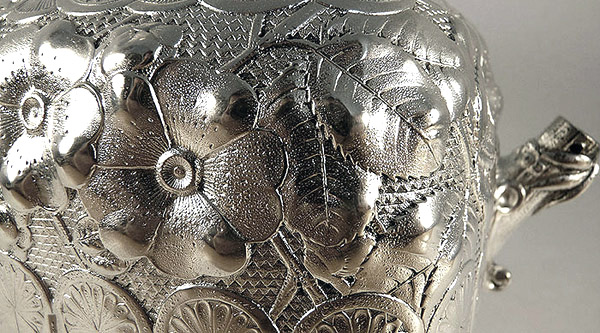
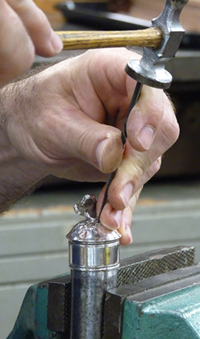
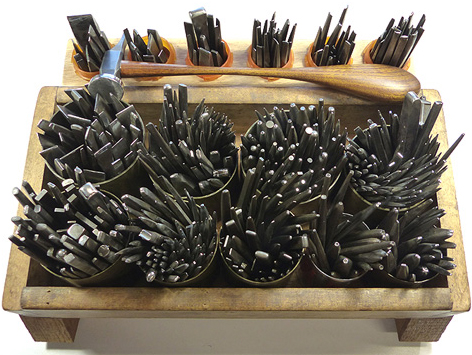
Chasing:The
technique of detailing the front surface of a metal article by
indenting with various hammer-struck punches. This process does not
remove metal, but reshapes it. Chasing is demonstrated here.
This technique is demonstrated in the second part of the video. See
an example of a chased Tiffany teapot here.
Chasing
Chasing Punches
and Hammer
Checking:
The hammering down onto the edge of a form. This technique
strengthens and visually thickens the edge. See this piece.
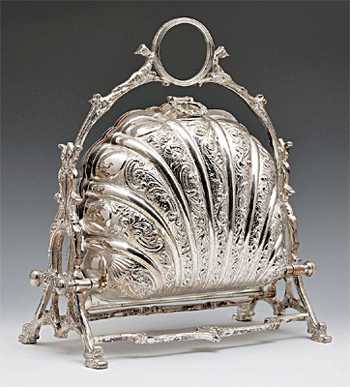
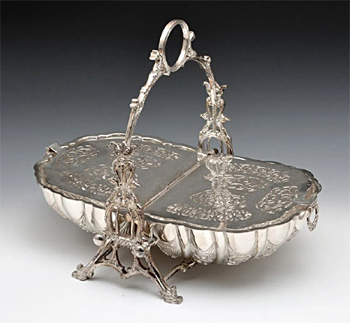
Clam
Shell
Biscuit/Bun Warmer: A table accrssory popular during the
18th and early 20 centuries for keeping buns, biscuits, and other
baked goods warm.
Coin
Silver:
Coin silver in America was a variable alloy; the purity of metal
matching, in theory, that of contemporary currency. Occasionally,
during periods of shortage, coins were literally used as metal stock,
especially in the colonial era. Because of the multiplicity of
coinage in use from foreign countries (such as the Spanish reale), it
has varied from 83.5% to 92.5% silver with the remaining percentage
copper. This also holds true of those objects that were melted down
and refashioned. It was never an enforceable standard like sterling,
but was a means for silversmiths, lacking a national standard of
assay, to assure clients of the quality of their silver. By the
1820s, with flat-rolled silver stock readily available, it became an
arbitrary benchmark set at 90% pure silver, and remained so until the
British sterling standard was adopted by Gorham in 1868 to compete
with British-made silver. Other manufacturers followed suit. Any
object stamped with the word "sterling" or .925 is a
legally enforceable standard. Though sterling must contain at least
92.5% fine silver, any other metal can be used for the remaining 7.5%.
Colloidal
Silver:
A liquid suspension of microscopic particles of silver. A colloid is
technically defined as particles which remain suspended without
forming an ionic, or dissolved solution. The broader commercial
definition of "colloidal silver" includes products that
contain various concentrations of ionic silver, silver colloids,
ionic silver compounds or silver proteins in purified water.
Colloidal silver with concentrations of 30 parts per million (ppm) or
less are typically manufactured using an electrolysis process,
whereas colloidal silver with higher concentrations of 50 ppm or more
are usually either silver compounds such as silver chloride and
silver iodide or are solutions that have been bound with a protein to
disperse the particles.
Currently,
colloidal silver is marketed as an alternative medical remedy, though
there is no scientific evidence of its effectiveness for any medical
condition. Excessive use can result in argyria, a form of silver toxicity.
I. History and Applications
Prior to 1938,
colloidal silver was widely promoted as a "cure-all," and
silver products were prescribed by physicians as topical antibiotics.
However, with the development of more effective, less expensive
antibiotics such as penicillin and sulfanilamide, medical use of
colloidal silver ceased. From approximately 1990, there has been a
resurgence of the promotion of colloidal silver as an alternative
medicine treatment, marketed with claims that it can prevent or treat
numerous diseases.
Colloidal silver
products are legally available at health food stores in the United
States and Australia and are marketed over the Internet as a dietary
supplement. It is illegal in the U.S. and Australia for marketers to
make claims of medical effectiveness for colloidal silver, but some
websites still list its use for the prevention of colds and flu, and
the treatment of more serious conditions such as diabetes, cancer,
chronic fatigue syndrome, HIV/AIDS, and tuberculosis, among other
diseases. Colloidal silver has been found to lack any antimicrobial
effect, and there is no medical evidence that colloidal silver is
effective for any of these claimed indications. Silver is not an
essential mineral in humans; there is no dietary requirement for
silver, and no such thing as a silver "deficiency."
Currently, there
are no evidence-based medical uses for colloidal silver. There are no
clinical studies in humans demonstrating effectiveness, and several
reports of toxicity. The U.S. National Center for Complementary and
Alternative Medicine has issued an advisory indicating that the
marketing claims made about colloidal silver are scientifically
unsupported, and that the silver content of marketed supplements
varies widely and can pose risks to the consumer.
II. Toxicities and
Interactions: Argyria
Excessive intake
of silver products may result in a condition known as argyria, one
symptom of which is blue or gray discoloration of the skin. The
discoloration occurs when silver is deposited in the skin and then
darkened by sunlight, just as silver particles in photographic film
darken when exposed to sunlight. Localized argyria can occur as a
result of topical use of silver-containing remedies, while
generalized argyria results from the ingestion of colloidal silver.
Arygria is usually permanent, and there is no known effective
treatment. While argyria is usually benign and limited to skin
discoloration, there are isolated reports of more serious neurologic,
renal, or hepatic complications. A death has been reported in the
medical literature as a result of colloidal silver use; in that case,
a 71-year-old man developed status epilepticus which the authors felt
was due to silver toxicity.
A number of case
reports describe argyria after ingestion of colloidal silver marketed
as an alternative-medicine treatment. Colloidal silver may
theoretically interact with some medications, including tetracycline
and quinolone antibiotics and penicillamine, reducing the
effectiveness of those medications.
III. Government Regulation
In August 1999,
the U.S. Food and Drug Administration (FDA) banned colloidal silver
sellers from claiming any therapeutic value for the product, noting
that such products were being marketed for numerous diseases without
evidence of effectiveness. The FDA also banned over-the-counter sale
of drug products containing colloidal silver due to the lack of
safety or efficacy data. The product now has the status of a dietary
supplement in the US; it can be promoted with general
"structure-function" claims, but cannot be marketed as
preventing or treating any illness.
Following this
ruling, the FDA has issued numerous warnings to Internet sites which
have continued to promote colloidal silver as an antibiotic or for
other medical purposes.
In 2002, the
Australian Therapeutic Goods Administration (TGA) ruled that
colloidal silver-containing products were no longer exempt from
therapeutic goods legislation and had to meet the requirements of
other products covered by this law. The TGA found that "there
are no current legitimate uses of colloidal silver and that the
Surveillance Section of the TGA be requested to investigate the
illegal availability of colloidal silver products because of concerns
about their significant toxicity. The reasons for the recommendation
were that:
There is little
evidence to support therapeutic claims made for colloidal silver
products; the risk to consumers of silver toxicity outweighs the
value of trying an unsubstantiated treatment, and bacterial
resistance to silver can occur; and efforts should be made to curb
the illegal availability of colloidal silver products, which is a
significant public health issue.
Coin
Silver: Coin (or Pure Coin, Dollar, Sandard) silver may
have a variety of marks or may not be marked at all. Coin silver
originally was made from melting coins from various
countries. These coins were minted using varying grades of
silver. The U.S. adopted a 900/1000 standard for American silver
coinage in 1837, but as silversmiths continued to use predominantly
foreign coins to make their silver goods, the actual silver content
of coin silver objects can vary.
The word Standard
used on silver indicates it was made to the U.S. silver standard
after 1837, so 90% pure. Please note that the word Standard can
also be used on silverplate to indicate something altogether different.
Due to the Assay
Act of 1814 passed in the State of Maryland, a mark of the Baltimore
Coat-of-Arms or the numbers 10-15, 10 oz 15, 1015, 11, 11 oz, or
11-12 also are an indication of coin silver.
Conservation:
Primarily dealing with cleaning an object, doing the least amount of
harm to its original finish.
Crimping:
A rapid raising process by forming radiating valleys from the center
to the outer edge of a metal object then raised. Generally used on
thinner gauge metal.
Cross-Peen
Hammer:
Hammers with long, narrow faces running perpendicular to the handle
and used for raising, forming, and planishing.
Depletion
Gilding: Term used for producing a pure gold surface on
an object by dissolving the copper in the alloy with acid. A more
accurate term for gold alloys is, for example: "18K gold,
surface copper depleted." For sterling and other silver alloys:
"sterling, surface copper depleted."
Die
Forming:
The process of stamping or hammering a sheet of metal into a form
which has the outline of the object. Also used when making duplicate objects.
Drawbench:
A narrow, waist-high bench equipped with a chain dragging a pair of
drawtongs (large coarse-toothed pliers) used to grip the end of a
piece of wire. This wire is then pulled through a series of
consecutively smaller dies (round, square, triangular, etc.) reducing
its thickness. Patterned dies may also be used to produce moldings,
boarders, etc. See a drawbench here.
Duty
Mark: (also called Sovereign's Mark): An additional mark
that was stamped certifying a variable tax was levied on all silver
and gold assayed in Great Britain from December 2,1784 to April 30, 1890.
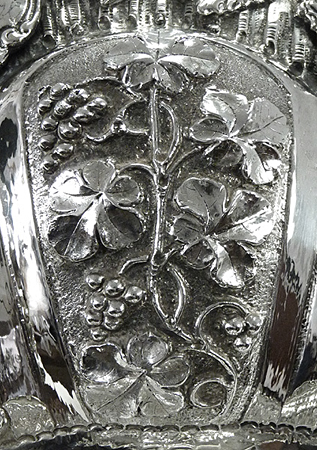
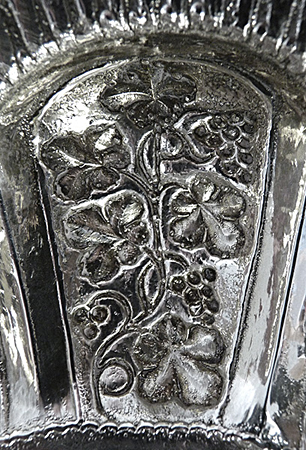
Electroforming
/ Electrotyping: The process of growing a metalic
object over a mandrel or into a mold. See an example here.
The image on the
left is an exterior panel of a fine silver bowl made in Greece. The
right image is the reverse of that panel showing the tiny nodules
that grew from inside the mold. This is one method in determining if
an object was hand made or a copy of an older piece. This process is
also used to make duplicate objects from new designs.
Electroplating:
Italian Luigi V. Brugnatelli invented electroplating by
electrolysis in 1805. But, it wasn't until the 1840s that John Wright
of Birmingham, England, discovered a more commercial process of
electroplating using potassium cyanide. George Richards Elkington and
Henry Elkington of Birmingham England – two cousins who began
their research during the industrial revolution – bought the
patent rights from Wright and were given the first patent for
electroplating in the 1840s.The process of putting a
metallic coating on a metal or other conducting surface by using an
electric current. It is used to improve the appearance of materials,
for protection against corrosion, and to make plates for printing.
The process: The
article to be plated is thoroughly cleaned of grease and dirt by
dipping it in acid and alkaline cleaning solutions. It is then put in
a solution of the metal with which it is to be coated. The metal
exists in the form of positive ions (atoms that have lost one or more
electrons). The article is connected to the cathode (negative end of
a source of electricity). The anode (positive electric terminal) is
connected to another conductor which is also dipped into the
solution. The electric current acts on the metallic ions in the
solution. The ions are attracted to the cathode, and the coating is
deposited on the article's metal surface. If the metal in the
solution and the metal of the positive terminal are the same, the
electricity may remove metal from the terminal to replace metal taken
from the solution.
The thickness of
the layer deposited on the article depends on the strength of the
electric current, the concentration of metallic ions, and the length
of time the article has been in the solution. The terms triple-plated
and quadruple-plated indicate various thicknesses of plating, not
separate layers deposited on the surface.
Ornamental and
protective platings are very thin, usually from 1/1,000 to 2/1,000 of
an inch (0.03 to 0.05 millimeter) thick. For plating gold, silver,
copper, zinc, and cadmium, cyanide solutions of the same metals are
often used. Copper and zinc may also be plated by acid-sulfate
solutions. Chromium is plated with a chromic-acid solution and nickel
is plated with nickel sulfate. Other metals plated for commercial use
include platinum, lead, and tin. Alloys of two or more metals may be
deposited by using a solution of salts of the metals that make up the
alloy. Examples of alloys used for plating are brass, black nickel,
lead-tin, and bronze.
Electroplating is
also used to reproduce medals or other objects in a process called
electroforming. This process was formerly known as galvanoplasty. One
kind of electroforming, called electrotyping, is the reproduction of
type forms and engravings for the printing industry.
Resource: Melvin
Bernstein, "Electroplating," Discovery Channel School,
original content provided by World Book Online, http://www.discoveryschool.com/homeworkhelp/worldbook/atozscience/e/177500.html,
11/15/2001
Electrum:
A naturally occurring alloy of gold and silver, with possible trace
amounts of copper and other metals.
Enamel:
As there are numerous types of enameling techniques, I'ts best to
direct you to Antique Jewelry University's enamel
page.
Engine
Turning: An engraving technique in which a very precise
intricate repetitive patterns or design is mechanically engraved into
an underlying material with very fine detail. It is engraving on a
two- or three-dimensional surface with a diamond stylus cutting very
specific designs, mostly linear. You've probably seen examples engine
turning on card cases, money clips, and dresserware. Engine turning
is also called guilloché after the French engineer
“Guillot,” who invented a machine “that could scratch
fine patterns and designs on metallic surfaces.” Engine turning
machines were first used in the 1500-1600's on soft materials like
ivory and wood and in the 1700's it was adopted for metal such as
gold and silver. The last machines were manufactured around 1948-1949.
The machine improved upon the more time-consuming practice of making
similar designs by hand, allowing for greater delicacy, precision,
and closeness of the line, as well as greater speed. Find more
information on engine turning and to see videos, go here.
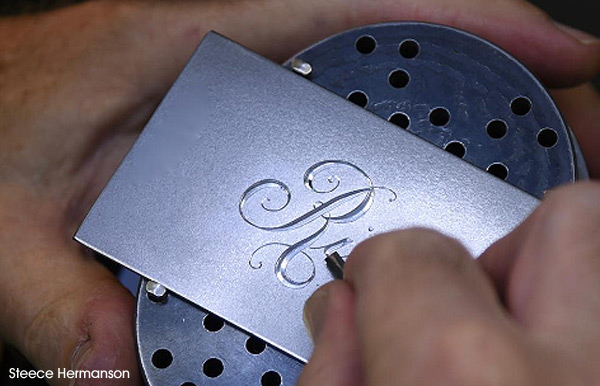
Engraving:
The process of cutting shallow lines into metal with a sharp graver,
reproducing artwork which has been drawn on a metal article. Unlike
machine engraving, hand engraving removes metal when cutting. See a
video here.
A fantastic engraving glossary can be found here.
Engraving
EPNS:
Electro Plated Nickel Silver.
Etching:
A process of dissolving metal with acid, leaving a recessed design.
The upper, unetched surface is sometimes engraved.
European
Rulers:An
abridged list from the Metropolitan Museum of Art includes kings and
queens whose rule affected the arts of Europe in important ways and
whose names are most commonly raised in art historical discussion.
See the list here.
European
Silver Quality Markings
Reprinted with
permission of Beer
Stein and Gary Kirsner Auctions
Note: The below
article was originally written for beer stein collectors. I have
removed that reference as the same alloys were also used on other
silver objects.
Numbers can
frequently be found on silver made in the various European countries.
While a few general rules exist, it is not always immediately clear
exactly what percentage of silver is present in a silver object. We
can find silver with numerical markings such as 12, 14, .800, .900,
.925, 925S, .830H, 84 and 88.
Austria-Hungary
Austria-Hungary,
having an historically German culture, used the Lothige system. The
marks that can be found on silver from these areas are 15, 14, 13 and
12, which equate to .9375, .875, .8125, and .750.
Denmark
Denmark’s
silver standard was based on 1000 parts. There marks are followed by
an S, such as 925S and 830S. The 830S mark is the most often seen
mark on silver from Denmark. Finland added an H to the numerical
mark, such as .925H, .830H and .813H. Belgium had a similar system
with an A following the numbers, but they changed to a simple .900 or .800.
England
Silvermakers in
England have used a sterling standard since 1544 when they marked
their wares with a lion passant. There are four or five required
marks found on silver items made in England. One of these marks is
used to indicate the sterling standard. There were a few brief
periods in which the standard in England was actually higher than
925/1000. The other countries in Europe that made silver all
had their own silver standards. The silver standard is usually
indicated on these objects.
France
France used a
simple numbering system of .950 or .800. However, these numbers were
represented by stamped marks that are variations of human heads. This
is a somewhat confusing system as it usually requires reference to a
book on silver marks.
Germany
Silver from the
1600s to the early 1800s used a measurement system called Lothige.
Markings were numbers such as 12 or 14. These numbers were divided by
16. Thus 12 Loth is 12/16 or .750 silver content and 14 Loth is 14/16
or .875 silver content. This marking system went out of fashion by
the 1880s. Silver items made in Germany after 1888 are marked .800
(this is 80% silver content), and this is the standard for silver
pieces made in Germany from that time on. A small crescent moon and a
small Imperial crown always accompany the .800 mark on German silver
items made after 1888. Note that the Imperial crown does not indicate
that the maker had something to do with the Imperial court.
Do not assume that
12 necessarily means Loth. Manufacturers of silverplate in Germany
have been known to use a simple 12 stamp into the metal with no
reference to Loth at all. Several lids have been seen carrying that
numerical mark over the years. Plating was invented in 1840 and
prolific in Europe by 1860. Since there was little if any control by
the silver regulators, markings on silver-plated items can create confusion.
Italy
Starting in 1872,
Italy used a similar marking system with female heads indicating
.950, .900 and .800 fineness. More modern items produced in Italy
used a flag with a number 1 (for .925) and a flag with a number 2
(for .800).
Netherlands
The silvermakers
in the Netherlands used the old city marks in the 17th and 18th
centuries, which guaranteed .875 fineness. Starting in 1814 they
changed to a mark of a standing lion with a 1 (equivalent to .934) or
standing lion with a 2 (equivalent to .833).
Norway
In 1891 Norway
started using the 1000 part system with an S either before or after
the number, such as S830 or 830S. In Norway .830 is the lowest
allowed purity.
Russia
Silver made in
Russia was marked with numbers such as 84. The base or 100% pure
number was 96, which was called a Zolotnik. An item marked 84 would
be 84/96 or .875 pure silver. Other numerical marks that can be found
on Russian silver include 88 (.9166 pure) and 91 (.9479). Russian
silver was usually profusely marked. It is normal to find numerous
marks on each part of a Russian silver beer stein, including the
body, the lid and the handle.
Sweden
The marking system
in Sweden was based on the Lod, which was similar to the Loth system
with 16 being equivalent to 1000. The marking system in Sweden later
changed to the 1000 parts system. Norway used a marking system
similar to Sweden for older silver items.
Switzerland
Switzerland used
the Lothige system until 1880 when they set standards of fineness at
.935, .925, .900, .875 and .800. All silver items made in Switzerland
after 1882 also have a bear or a grouse as part of the mark.
Finishing:
Processes, accomplished either by hand or mechanical device with
suitable compounds, to produce a desired surface.
Firescale:
A scale that develops on the surface of non-ferrous objects
which had no protective flux during brazing. This cupric oxide layer
must then be removed chemically or by abrasive methods.
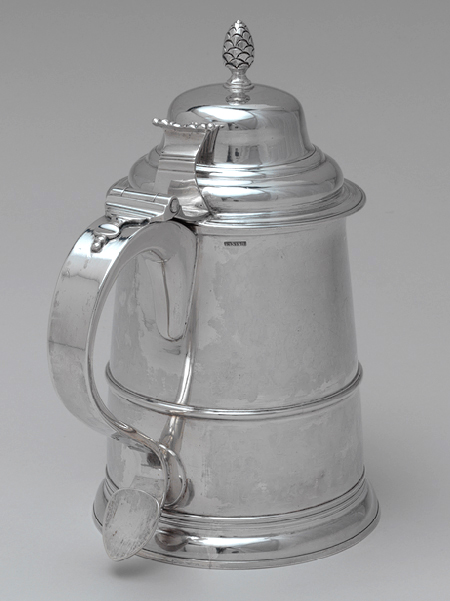
Firestain:
Oxidized copper (shown as the dark, blotchy areas on the
tankards below) in solid silver can be found on many pre-colonial
through early twentieth century pieces. If after cleaning your silver
(not silverplate) piece a purplish stain remains, do not mistake this
stain (cuprous oxide) for tarnish! Attempting to remove it will only
damage your prized piece. It is not generally seen on pieces that
have been produced by the large American silver companies after the
early 1900s, but many one-person silversmithing shops still use this
technique. I will not get into the technicalities of firestain here,
except to say that the stain is usually obscured with fine silver
either by silver plating the object or through a process called
copper depletion. The firestain under this fine silver layer, which
may be a few thousandths of an inch thick, may not show up until
after many years of polishing.
"Paul Revere,
Jr.: Tankard (33.120.507)". In Heilbrunn Timeline of Art History.
New York: The
Metropolitan Museum of Art, 2000–.
http://www.metmuseum.org/toah/works-of-art/33.120.507
(October 2006)
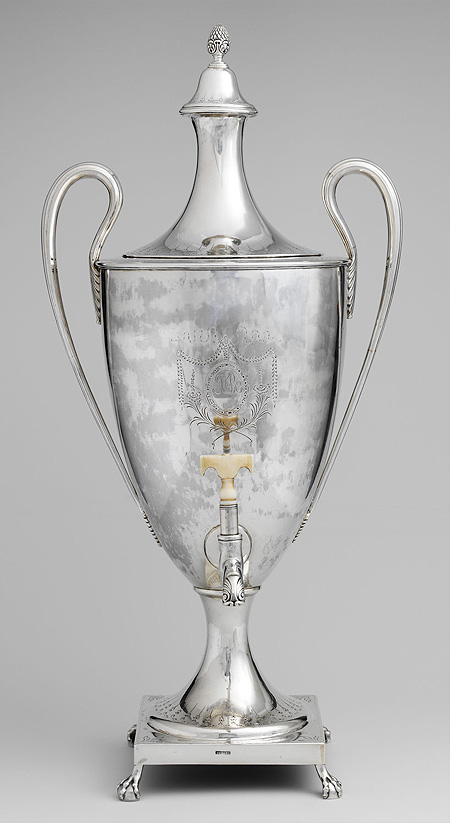
Paul Revere, Jr.
Urn, The Metropolitan Museum of Art, Accession Number: 1990.226a–d
Fold
Forming:
Fold forming is a new, quick, easily learned way of shaping sheet
metal with hand tools. Forms are derived from the natural plasticity
and ductility of the metal. Lewton-Brain invented fold-forming, which
is internationally recognized as a new way to work metal. Shaping is
extremely efficient and rapid (many take 3-7 minutes working time).
Tools are simple: fingers, hammers, anvil, and mill. Complex relief
forms are made from sheets of metal often on one annealing. They
resemble chased, constructed, and soldered forms, and can be made
with most metals, including steel.
Forging:
A process that has as its primary purpose: the alteration of the
original thickness and cross-section of metal. This is usually
through hammering wire, rods of metal, ingots (as would be forged
into sheet by modern day Colonial Williamsburg silversmiths), or
heavy sheet stock (for forming most flatware).
Forming:
A process which has as its primary purpose: altering a sheet of
metal so that it changes planes, three-dimensionally. Changes in the
metal's thickness are incidental by-products of the process of forming.
Frauds
(excerpted from Old London Silver, 1903 by Montague Howard)
This is a
fascinating area of study!
THE Goldsmiths'
Company of London was incorporated in the year 1327, and ever since
that time there have existed laws against the making of counterfeit
silver. This company not only assays and hallmarks London-made
silver, but it also has the right to destroy spurious articles, and
inflict fines upon those who have done the counterfeiting.
At one time, in
England, to forge plate was punishable with death, although we do not
understand that this penalty was ever enforced. However, we do know
that in the year 1597 two goldsmiths who produced some counterfeit
silver were put in the pillory, and each had one ear cut off.
It is not proposed
to enter into the consideration of the penalties that are now imposed
for counterfeiting, but to state briefly the different modes of
forging plate, and the means whereby one can detect such frauds. In
ancient times base metals were sometimes plated and sold as solid
silver. This is seldom, if ever, done at the present time. Prior to
the 1st of October, 1844, 22-carat gold wares and silver articles
were hall-marked with the same marks. This uniformity of marks on the
two metals was taken advantage of to defraud the public by gilding a
silver piece of plate and then selling it for gold. To remedy this, a
law was passed in 1844 which changed the hallmarks on gold – a
crown with the figure 22 was introduced in place of the lion.
For many years
silver articles have been made below the standard, and the hallmarks
surreptitiously placed upon them. From 1784 to 1890, when there was a
tax upon every piece of silver that was made, the Goldsmiths' Company
collected the duty, indicating that it had been paid by placing upon
the silver the mark of the sovereign's head. This duty at times was
eighteen pence an ounce. To avoid paying it, the scheming silversmith
would place (by means of counterfeit punches) the hallmarks on his
own silver. This temptation to avoid taxation was removed in 1890 by
the abolition of the duty. Before this was done, it was easier to
convict a counterfeiter of plate, for then there were two charges on
which to precede against him, namely, fraud and the evasion of taxes.
Frauds may be
considered under the following heads: Subtractions, Additions,
Transformations, Transpositions and Counterfeit Marks.
Subtractions
By the term
subtraction is meant the removal of a portion of silver from an
article after it has been hall-marked; as the foot from a paten in
order to make it into a salver, or a spout from an urn to change it
into a cup. Although in some cases this is a form of deception, it is
believed that no prosecution at law would succeed where a subtraction
has been made.
Additions
Under this heading
are classed hall-marked articles to which additions have been made by
the silversmith. The law says that consent must be obtained of the
authorities before making an addition, and that if the change
increases the weight of the article to more than one-third of its
original weight the added silver must be hallmarked. But the addition
should not change the character of the article; a foot, a handle or a
spout may be added, but not so that it changes the use of the
article; thus one must not alter a tankard into a coffee-pot. The
commonest forms of additions are as follows:
(1). An old and
rare article is plated inside to increase its weight, after which
gilding is used to hide the newness of the plating. Where an old
piece of plate is worth £10 ($50) an ounce (old silver is almost
always sold by the ounce in England), one can readily see the
temptation to increase the weight.
(2). A pierced
border is often added to a plain salver in order to make it more
attractive and salable. When this is done the designing silversmith
does not have the border marked by the Goldsmiths' Hall, because
there they would put on the modern marks, and the silversmith, of
course, wants only the old marks, which, in this case, would be on
the bottom of the salver.
(3). Frequently
old teapots, jugs, kettles, etc., have modern chasing or engraving on
them, but this is permissible and can readily be detected by the
expert. It is generally done to please the owner of the article and
not to deceive or enhance the value; in fact, the chasing or
engraving in many cases renders the piece less valuable in that it
alters its antique character. On the other hand, this surface
alteration, if done in the style of the period when the piece was
made, sometimes increases the value of the article by making it more
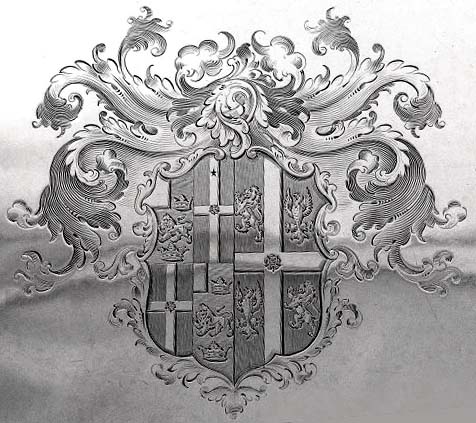
decorative. A very common form of fraud is to engrave an old piece of
silver with the crest and coat-of-arms of some celebrity, often
adding an interesting inscription.
Transformations
When a piece of
plate is changed into another article it is called a transformation.
This form of forgery is practiced to make an article more desirable,
and it is the commonest kind of counterfeiting. Examples of
transformations are as follows: Sauceboats are made into three-legged
basins – chiefly Irish ones; wine funnels into pierced baskets;
meat dishes into waiters; dishes, plates or waiters into bowls or
baskets; pint mugs into jugs; Queen Anne saucepans into tankards;
spoons into forks; skewers into handles of spoons or ladles.
When an article is
transformed the marks are not touched; but in changing the form of
the piece the marks often become twisted or defaced, and frequently
appear in the wrong place, and sometimes upside down. In the chapters
describing the different articles, much attention has been paid to
the correct positions of the hallmarks on the various pieces.
Transpositions
A fraud is termed
a transposition when a genuine mark has been removed from an old
piece of silver and inserted into a new article made to resemble an
old one, or put into an old piece that has no marks on it, or
inserted into an old hall-marked piece after removing the original
marks – in the last case the inserted marks are much older than
the original. The genuine mark is taken from some small and
inexpensive article; for instance, an old spoon-handle with the
Dublin marks on it will be inserted into the rim of a modern Irish potato-ring.
In order to insert
a mark, solder, in most cases, must be employed, and a cursory
examination of the piece would not detect the presence of the solder
marks. But if suspicion is aroused, the existence of solder can be
discovered in one of the following ways: by using a magnifying glass,
by polishing the surface of the silver and breathing on it, by
applying sulfur fumes, or by means of the blowpipe. The solder is
sometimes hidden by a little chasing.
Counterfeit Marks
A counterfeit mark
is one that has been stamped by a punch other than that of the
Goldsmiths' Company, or it is a genuine mark altered in one way or
another. A forged punch is made of the hallmarks of a hundred years
ago; this is used to mark modern silver and in that way make it
appear old. Another way is to reproduce exactly an old piece of
silver, including the old marks, by means of the electrotyping
process. When this has been done, an expert can tell it at a glance
by the appearance of the silver.
The mark of the
Sovereign's head is sometimes removed to make the marks appear older.
Another way of altering the marks is to remove an unimportant maker's
mark and substitute a much sought after mark, such as that of Paul
Lamerie, which advances the price of the article at least £2
($10) an ounce. Modern articles, made of Britannia Standard, are
sometimes sold as Queen Anne's pieces, on account of the resemblance
of two of the modern marks to the old ones.
How to Detect Frauds
Having considered
the principal methods of forging plate, the question now presents
itself, how can we determine whether a piece of silver is antique or
modern? We will answer that question by explaining what an expert
does when his suspicions are aroused. He can have a portion of the
article assayed to see if it be of the proper standard. He considers
the style of the period that the hall-marks call for; frequently the
counterfeiter does not pay much attention to this matter. The expert
looks carefully at the piece to see how it was made – the ways
of manufacturing silver have changed from time to time. The
appearance of antique silver is very difficult to imitate, and
although it is almost impossible to describe just what this old
appearance is like, nevertheless it is quite real to one accustomed
to examining plate. While the price of an article of old silver does
not necessarily prove its antiquity, nevertheless if one is offered
by a dealer an antique much below the current price, it may be an
indication that something is wrong. Defects in an article must not be
taken as signs of age, for they are very easy to produce. One must be
careful that the article does not antedate its introduction; for
instance, an expert would not buy an Elizabethan teapot, or a
four-pronged fork of the time of Henry VIII.
Articles made
since the time of Elizabeth, with only a maker's mark, should be
avoided, although the unscrupulous dealer will show you in some book
of reference that it is the mark of a celebrated silversmith. Such
pieces are seldom genuine. The forger escapes penalties by leaving
off the hall-mark, as there is no penalty for simply copying the
maker's mark. Of course, no such piece could be sold openly in
England, for, unless hall-marked, it is liable to conf1scation; but
in America, where there are no restrictions, the opportunity for
deception is easy, and forged goods are specially made for this market.
Almost every
country in Europe has made spurious silver articles, or
"duffers," as they are called in the trade. France has
perhaps produced the cleverest, Holland the worst, and England the
most. America is the last sinner, and in New York City
"duffers" are being produced in small quantities. They are
very poorly done, and such stupid blunders are made in the hall-marks
that it is very easy to detect the counterfeiting.
On account of the
unselfish energy of a few prominent silversmiths in London, backed up
by the Goldsmiths' Company, some very heavy fines were recently
inflicted upon several well-known dealers in forged plate. This put
consternation into the camp of counterfeiters, and as a consequence
there is a temporary diminution in the supply of spurious old silver.
The process of
identifying a fake or forged piece of silver...
Fused
Plate: Excerpted and edited from Sheffield Plate: Its History,
Manufacture and Art by Bertie Wyllie (London, 1908). Sheffield plate
[fused plate] is the name applied to a variety of articles of
domestic use or ornament, made of copper coated with silver by a
special and now abandoned process. Many of them were actually
manufactured in Birmingham, but as the secret of producing the
material was discovered and brought to perfection in Sheffield, the
name of that town was naturally connected with it, and thence
transferred to articles constructed from it.
In 1742 a workman
named Thomas Bolsover was mending the handle of a knife made of
silver and copper, when, accidentally overheating it, he caused the
metals to fuse and flow, and found that as a consequence the silver
adhered to the copper as a thin coating. Being an intelligent man, he
perceived the commercial value of his chance discovery, and began the
manufacture of articles which, with all the appearance of silver,
were both cheaper and stronger than those made of the pure metal. He
apparently, however, confined himself to applying the silver direct
to the surface of the copper after the latter had been given the
shape destined to it, and was thus limited to the production of small
articles such as snuffboxes, knife handles, toilet articles, etc. It
was reserved to Joseph Hancock to realize that by making the plate
first and working it into the desired form afterwards he could almost
indefinitely extend the possibilities of the material.
The process in its
final and highest development was as follows. The groundwork was a
mixture of copper and brass, either metal alone having serious
defects. This was cast into an oblong ingot, one to 12 inches in
thickness, 21 inches in breadth, and of a length regulated by the
size of the plate desired. The surface of this was brought by
planing, grinding and other means to the highest possible pitch of
smoothness and evenness. A sheet of silver of a finer quality than
standard, with a thickness up to one inch according to the quality
aimed at, and of the same superficial extent as the copper bar, was
leveled and polished in the same way and accurately fitted to it,
neither surface at any time being soiled by contact with the
workman's fingers. A sheet of copper, rather smaller than the other
two and in. thick was laid upon the silver, and on the top of all was
added a piece of iron, four inches thick, one inch wide, and a little
shorter than the three others, to protect them from the direct
contact of the strong iron wire with which all were firmly bound
together. The junction of the edges of the silver and copper blend
was treated with a flux of borax and the whole was submitted to the
heat of a furnace until the silver was seen to be melting, when it
was instantly removed, care being taken to avoid pressing upon the
upper or lower surfaces, as the liquid silver in that case would have
been squeezed out from between the two enclosing plates and the
operation ruined. It was then left to cool, and after being
thoroughly cleansed presented the appearance of a copper ingot with
one silver side. This was passed again and again between gradually
approximated rollers, with occasional annealing, until the desired
thickness had been attained. The great extension of surface thus
produced had the drawback of exaggerating any small defect in the
union of the two metals, increasing it to a blister of an inch or
more in diameter. It was, however, fortunately found easy to remedy
this. The blister if unbroken was heated, pricked, and then rubbed
level with a burnisher; if, as sometimes happened, the silver had
flaked away it was replaced by coatings of pure leaf silver rubbed in
with a burnisher. The plate when passed as flawless was cut into the
desired form and molded as far as possible into shape, the edges
where necessary being soldered. At first only one surface of the
copper was plated with silver and thus its usefulness was necessarily
restricted, but it was a simple matter to apply the silver to both
sides and thenceforward whatever was made in solid metal could be
reproduced in plate, and firm after firm went into the business, ever
and anon introducing further improvements.
The possibility of
embossing the metal beyond a certain point without fracturing the
coating of silver was remedied by casting or stamping the raised
ornament in silver, filling the hollows with a form of pewter, and
soldering the result to the appropriate part of the general design.
Another difficulty, the concealment of the inner core of copper which
was seen as a thin red line when a cut edge was exposed, was met
about 1784 by George Cadman, who adopted the practice of soldering on
an edging, generally ornamented, of solid silver so as to cover the
junction, and the presence of this is one of the trustworthy tests by
which genuine Sheffield plate may be recognized. The labor of rolling
the metal by hand was done away with about 1760, by the firm of
Tudor, Leader & Sherburn, who first employed horse-power, and for
more than half a century the trade both in Sheffield and Birmingham
continued to flourish. In 1736 there were under 10,000 inhabitants in
the former city; in 1760 when Horace Walpole passed through it,
buying for two guineas a pair of candlesticks of the local plate,
which he thought "quite pretty," and pronouncing it to be
"one of the foulest towns in England," there were
two-and-twenty thousand who remitted eleven thousand pounds a week to London.
Below is an
engraving plate in solid sterling that was set-in a meat cover. This
practice is used so gravers won't cut though the sterling layer and
into the copper that is used in fused plate objects.
It would be
impossible, were it desirable, to enumerate all the varieties of the
articles turned out, or to overpraise the beauty and elegance of most
of them. The designs were identical with those in favor with the gold
and silversmiths of the period, which was happily one when
exceptionally good taste prevailed. The appreciation of light and
well-proportioned curves and the skillful employment of well-contrived
pierced work are conspicuous features.
The success was,
however, doomed to be short lived and to come to an end as swiftly as
it had grown up. In the year 1800 W. Cruikshank was already
experimenting with a process of electro-plating, and in 1837 Mr.
Spencer in England, and in 1838 Professor M. H. Jacobi (1801-1874) in
Russia, working independently, succeeded in contriving methods which
could be made commercially profitable. Two years later Messrs
Elkington in London and M. de Ruolz of Paris started in business on
those lines, and the slower and consequently more costly manufacture
at Sheffield and Birmingham rapidly died out.
Of recent years
old Sheffield plate after long neglect has come into fashion again,
and genuine articles in good condition have greatly gone up in value,
often exceeding in cost those of more modern date in sterling silver.
Concurrently fraudulent imitation has regrettably increased. In some
cases the whole object is a modern reproduction in electro-plate, but
more often really old articles from which the original plating has
been worn off in course of time have been replated, both equally
being in the eyes of the connoisseur, unworthy of serious attention
and comparatively valueless. The difference after a little experience
is not difficult to detect, though inexpressible in words. The
pressure to which the Sheffield plate was submitted produces a
definite color and texture which is absent from the surface produced
by the deposit of silver in a liquid medium by electrical means, and
the coat of silver is spread by the latter uniformly over the whole
surface without a break, while in the former the junction between the
embossed ornaments and the silver strips covering the cut edges may
often be detected on careful examination.
Georgian
Silver: The Georgian period refers to the consecutive
reigns of 4 King Georges; George I: (August 1, 1714 – June 11,
1727), George II: (June 1727 – 25 October 1760), George III:
(October 25, 1760 – 29 January 29, 1820), George IV: (January
29, 1820 – 26 June 26, 1830). Find a complete list of European
rulers here.
This period, of
over a hundred years, was long enough to see massive economic, social
and political change. Likewise the silverware of the period varies
massively in style and technique. In the George I period and the
middle of George III's reign, we find some of the simplest silverware
designs ever produced in English silver whilst in the late George III
period and throughout George IV's reign we find some of the most
ornate pieces of silverware.
German Silver:
An alloy that resembles sterling, but contains only copper, zinc,
and nickel.
Hallmark:
A mark or series of marks stamped or laser-engraved by a country's
assay office indicating the quality of the precious metal tested
(e.g., "Sterling," ".925," ".840,"
".800," or an image of a rampant lion—indicating
sterling as used in Great Britain). The object may also contain the
country, maker's mark, housemark, duty mark, import mark, etc.
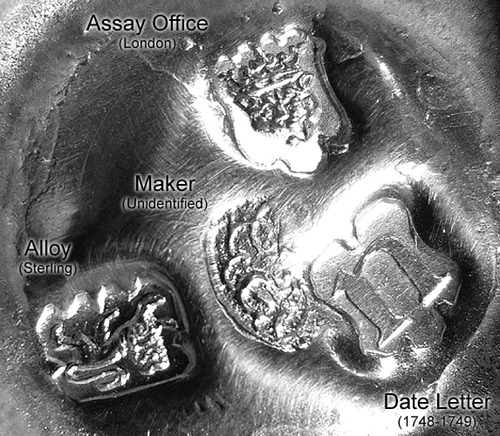
Below are actual
hallmarks on an English object with the following stamps:
• Assay
Office: crowned leopard's head (London)
• Alloy:
rampant lion (shown here upside down) indicates sterling
• Date
Letter: n (1748-1749)
• Maker:
unidentified because it was carelessly over-stamped with the date letter
• Additonal
British examples
Hallmark
Head:
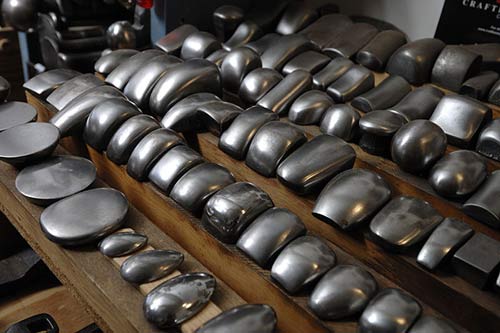
A short, polished, cast metal mushroom-type stake that fits into a
horse and is used for planishing and burnishing metal objects over.
Heads
Horse:
Held in a vise, this straight or L-shaped holding devise
accommodates heads. The length of a horse varies depending on the
size or depth of the piece being fashioned. See some horses here.
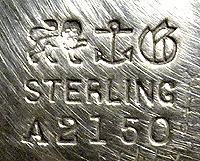
Housemark:
A mark stamped or laser-engraved by the company (e.g.,
"Gorham," "Reed & Barton,"
"Tiffany," "Kalo") that created the object for
its own line or for a retailer (e.g., "Shreve, Crump &
Low," "J.E. Caldwell Co."). In addition, there
may also be a maker's mark, indicating the company's craftsman
who created or oversaw the creation of the object. The below example
identifies the object's maker as Gorham Manufacturing Company from
Providence, RI; the metal quality (sterling); and the object's design
number (A2150).
Housmark
Insulators:
Coffee and teapots are normally found with ivory, plastic, hardwood,
or compressed fiber positioned between the body and handle to block
heat transfer of the liquid to the handle. Insulators can also be
found on other objects, such as water kettles and burners, that may
transfer heat to the handle.
Laser
Welding: A technique used to join or fill metal through
the use of a laser. The beam provides a concentrated heat source,
allowing for narrow, deep welds and high welding rates.
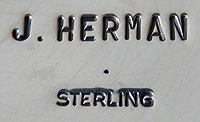
Maker's
Mark:
Sometimes called a "touchmark." The name or artistic mark
stamped, engraved, or laser-engraved on an object created by an
individual silversmith or jeweler. The mark below is that of Jeffrey Herman.
Maker's Mark
Metals
First
Used
8700 BC
4000
3000
2000
1600
1300
1000
200 AD
1260
1634-1776
1776-1868
1717
1738
1774
1825
1868
1912
Copper
Gold
Silver
Bronze is used for weapons and armor
Crude iron metallurgy developed
by the Hittites
Steel invented
Pewter first used in China and Egypt
Cast iron widely used in Han
Dynasty China
Sterling first used in Europe
Sterling used in America per the
English standard
Coin silver widely used in America
Iron invented by Abraham Darby
Zinc processed by distillation
from calamine and charcoal patented by William
ChampionManganese discovered by
Johann Gottlieb Gahn
Metallic aluminum produced by
Hans Christian Ørsted
Sterling standard permanently
adopted in United States
Stainless steel invented by Harry Brearley Silver
Standards Around the World
Model
Making: Numerous processes and materials used to produce
casting patterns that will then be duplicated in metal or other materials.
Mokume-Gane:
Laminated metals that have been fused or brazed together like a
sandwich, and passed through a flat or wire-forming rolling mill to
make the material easier to fabricate or raise. The sandwich or
"billet" can also be forged without the use of the rolling
mill. Patterns are then punched, filed, and hammered to produce a
desired pattern. See examples of Mokume here.
Nickel Silver:
An alloy that resembles sterling, but contains only copper, zinc,
and nickel.
Niello:
A black metallic alloy of sulfur, copper, silver, and usually lead,
used as an inlay on engraved or carved metal. The Egyptians are
credited with originating niello decoration, which spread throughout
Europe during the Middle Ages.
Ormolu:
An 18th-century process whereby powdered gold is mixed with mercury
and the resulting paste is brushed onto a copper, brass, or bronze
cast or fabricated form. The form is then fired at a temperature that
causes the mercury to evaporate, leaving a gold deposit on the
surface. The gold is burnished or matted to give the greatest effect
of metallic brilliance. (During the second half of the 19th century,
pieces were gilded by electroplating, and these are often
inaccurately referred to as ormolu.)
Patina:
In the decorative metals world, patina can mean three things:
1. The fine scratches on an object that have developed over time from
handling and polishing, 2. The natural darkening that is seen in the
recesses of ornamental pieces and engraving, 3. A factory-applied
chemical used to darken the recesses of a design to enhance its
details and give it a three-dimensional look. See an example here.
Patinate
/ Repatinate:
To apply or reapply a chemical to darken the recesses on ornamental
pieces and engraving that had naturally developed over time. This
process is sometimes applied to objects that have had their darkening
removed from dishwashers or chemical strippers such as Tarn-X. You
can see the results of repatinating here.
Planishing:
The act of hammering or refining the surface of a metal object with
highly polished hammer faces. This process refines the surface after
raising and may be used as a decorative element. Great care must be
used, for even a speck of dust will make an impression in the metal
being hammered. See an example of a planished surface here.
Polishing:
The process of refining a metal surface by use of abrasive compounds
applied by hand or a polishing wheel attached to a long-spindled
motorized arbor which runs at high speed. Various finishes may be
obtained with a wide variety of abrasive compounds applied to the
polishing wheels such as rouge–this compound imparts the
brightest finish. More abrasive compounds will produce less
reflective finishes, emphasizing the object's form.
Preservation:
To stabolize an object from further deterioration. This may entail
using an archival wax to maintain the surface finish.
Pseudo-Hallmark:
A series stamps found on plated or sterling objects made to resemble
a genuine British hallmark.
Raising:
The technique of forming a flat sheet of metal over a cast iron
T-stake or head, forming and compressing the metal to take a hollow
form. This labor-intensive process is the purest form of silversmithing.
Refinish:
To make an object look new by removing all scratches and imperfections.
Repair:
To fix (best possible outcome) a damaged or worn area on an object.
Repatinate:
See Patinate.
Repoussé:
A technique used to roughly emboss a metal object with ornament from
the back or inside with larger punches than those used in chasing.
This process does not remove metal, but reshapes it. Repoussé
is demonstrated here.
The technique is demonstrated in the first part of the video. See an
example on a Tiffany piece here.
Restoration:
To either make an object or damaged area on that object
look new, or to make it look its age without any noticeable damage or repairs.
Restore:
To repair and finish an object to its original condition.
Rolling
Mill:
A hand, waterwheel, or motor-driven mill with polished or patterned
hardened steel rollers that reduce the thickness or impart a texture
on metal sheet or wire. A rolling mill functions like a hand cranked
clothes ringer.
Paul Revere was
rolling copper plate with the assistance of water power as early as
1801. In 1803, the American navy commissioned Revere to roll copper
to sheath America's naval war ships.
Scratch
Brush:
A long-spindled motorized arbor using fine wire wheels rotating at
slow speed, burnishing the surface of a metal object after soldering.
Soapy water is used as a lubricant between the wheel and object. May
also be used as a texturing wheel to soften the luster of metal.
Silver, symbol Ag,
white, lustrous metallic element that conducts heat and electricity
better than any other metal. Silver is one of the transition elements
of the periodic table. The atomic number of silver is 47.
Silver has been
known and valued as an ornamental and coinage metal since ancient
times. Silver mines in Asia Minor were probably worked before 2500BC.
The alchemists called the metal Luna or Diana after the goddess of
the moon and ascribed to it the symbol of a crescent moon.
II. Properties
With the exception
of gold, silver is the most malleable and ductile of all metals. Its
hardness ranges between 2.5 and 2.7; it is harder than gold but
softer than copper. Silver melts at about 962° C (about
1764° F), boils at about 2212° C (about 4014° F), and
has a specific gravity of 10.5. The atomic weight of silver is 107.868.
Chemically silver
is not very active. It is insoluble in dilute acids and in alkalies
but dissolves in concentrated nitric or sulfuric acid, and it does
not react with oxygen or water at ordinary temperatures. Sulfur and
sulfides attack silver, and tarnishing is caused by the formation of
silver sulfide on the surface of the metal. Eggs, which contain a
considerable quantity of sulfur as a constituent of protein, tarnish
silver extremely quickly. Small amounts of sulfide, which occurs
naturally in the atmosphere and which, as hydrogen sulfide (H2S), is
added to natural gas used domestically, tarnish silver. The black
silver sulfide (AG 2S) is among the most insoluble salts in aqueous
solution, a property that is exploited for separating silver ions
from other positive ions.
III. Occurrence
Silver ranks about
66th among elements in natural abundance in crustal rocks. It occurs
in the pure state to a small extent; the most notable deposits of
native silver are in Peru and Norway, where the mines have been
worked for centuries. Pure silver is also found associated with pure
gold in the form of an alloy known as electrum, and considerable
amounts are recovered in the processing of gold. Silver is usually
found combined with other elements (of which sulfur is the most
predominant) in minerals and ores. Some of the important silver
minerals are cerargyrite (or horn silver), pyrargyrite, sylvanite,
and argentite. Silver also occurs as a constituent of lead, copper,
and zinc ores, and half the world production of silver is obtained as
a by-product in the processing of such ores. Practically all the
silver produced in Europe is obtained from the lead sulfide ore,
galena. In the United States relatively few mines are worked for
their silver alone—the silver is mined in conjunction with lead,
copper, and zinc. In 1988, U.S. mines produced an estimated 53
million troy oz. of silver, about 12 percent of the estimated 444
million troy oz. produced worldwide. Most of the silver mined in the
world comes from Mexico, Peru, Canada, the United States, and
Australia. The leading silver-producing states in the United States
are Nevada, Idaho, Montana, and Arizona; they accounted for about 71
percent of the silver mined in the United States in 1989.
IV. Metallurgy
Silver is usually
recovered from silver ores by roasting the ore in a furnace to
convert the sulfides to sulfates and then chemically precipitating
metallic silver. Several metallurgical processes are used to extract
silver from ores of other metals. In the amalgamation process, liquid
mercury, which forms an amalgam with the silver, is added to the
crushed ore. After the amalgam is washed out of the ore the mercury
is removed by distillation, leaving metallic silver. In lixiviation
methods the silver is dissolved in a solution of a salt, usually
sodium cyanide, after which metallic silver is precipitated by
bringing the solution in contact with metallic zinc or aluminum. For
the Parkes process, which is used extensively in separating silver
from copper and lead ores, see Lead. The impure silver obtained in
the metallurgical processes is usually refined by electrolytic
methods or by cupellation, a process that involves removing
impurities by vaporization or absorption.
V. Uses
The use of silver
in jewelry, tableware, and as coinage is well known. The metal is
usually alloyed with small amounts of other metals to make it harder
and more durable. In the United States, coin silver was an alloy of
90 percent silver and 10 percent copper until 1965, when the silver
content was reduced to 40 percent for half dollars; silver was
eliminated from dimes and quarters after 1964. In 1970 the U.S.
government sold the last of its marketable silver, which in earlier
periods of U.S. economic history had been used to support a monetary
system of bimetallism. Sterling silver for tableware and other
solid-silver objects is 92.5 percent silver and 7.5 percent copper.
Silver is used to coat smooth glass surfaces for mirrors by
vaporization of the metal or by precipitation from a solution;
however, aluminum has largely replaced silver in this application.
Silver is also widely used in the circuitry of electrical and
electronic components. Colloidal silver, dilute solutions of silver
nitrate (AgNO3), and some insoluble compounds, such as potassium, are
used in medicine as antiseptics and bactericides. Argyrol, a
silver-protein compound, is a local antiseptic for the eyes, ears,
nose, and throat.
The silver-halide
salts—silver bromide, silver chloride, and silver
iodide—which darken on exposure to light, are used in emulsions
for photographic plates, film, and paper. The salts are soluble in
sodium thiosulfate, which is the compound used in the photographic
fixing process.
Antimicrobial:
Destroying or inhibiting the growth of microorganisms and especially
pathogenic microorganisms (In Merriam-Webster Online Dictionary.
Retrieved November 30, 2008)
Silver is widely
used in topical gels and impregnated into bandages because of its
wide-spectrum antimicrobial activity. The antimicrobial properties of
silver stem from the chemical properties of its ionized form, Ag+.
This ion forms strong molecular bonds with other substances used by
bacteria to respire, such as molecules containing sulfur, nitrogen,
and oxygen. Once the Ag+ ion complexes with these molecules, they are
rendered unusable by the bacteria, depriving it of necessary
compounds and eventually leading to the bacteria's death.
Silverplate:
silver-plated objects may have a wide variety of marks, or may have
no marks at all. The following terms all indicate an item is
silver-plated: A1, AA, Coin Plate, Deepsilver or Deep Silver, Double
or Double Plate, Electroplate, EP, EPC, EPBM, EPNS, EPWM, Extra Coin
Plate, Extra Plate, Plate or Plated, Quadruple or Quadruple Plate,
Reinforced Plate, Silver Plate or Silverplate, Silver Soldered,
Sterling Inlaid, Sterling Plate, Triple or Triple Plate, XII, XIV, XS.
Silversmith:
One who fashions silver objects and wrought items such as forged
flatware. The first silversmiths who settled in this country set up
our banking system and produced its first coinage.
Sinking:
The hammering of a flat piece of metal into a concave hemispherical
shape in the top of a tree stump or any dished form. A small bowl
shape is formed in the center of the sheet producing a lip, enabling
the piece to "ride" the end of a raising stake, aiding in
the raising process.
Snarling:
The embossing from underneath or inside an object with a long-armed
steel tool, with one end placed in a vise. Snarling is accomplished
by placing a form over the snarling iron's tip (which may be any
shape) and tapping the back end of the arm which is secured in the
vise. The vertical vibration that results gives a "kick,"
raising a bump on the outside of the object. This technique is
usually used in conjunction with chasing.
Soldering:
A
process in which two or more metal items are joined together
adhesively, by melting and flowing a filler metal into the joint, the
filler metal having a relatively low melting point. Soft soldering is
characterized by the melting point of the filler metal, which is
below 800 °F. The filler metal used in the process is called
solder. Soldering is distinguished from brazing by use of a lower melting-temperature
filler metal; it is distinguished from welding by the base metals
not being melted during the joining process. In a soldering process,
heat is applied to the parts to be joined, causing the solder to melt
and be drawn into the joint by capillary action and to bond to the
materials to be joined by wetting action. After the metal cools, the
resulting joints are not as strong as the base metal, but have
adequate strength, electrical conductivity, and water-tightness for
many uses.This
technique does not possess the strength of brazing solders when
joining higher temperature metals such as silver. See a soldering
set-up here.
Spelter:
While sometimes used merely as a synonym for zinc, is often used to
identify a zinc alloy. In this sense it might be an alloy of equal
parts copper and zinc used for hard soldering and brazing, or as an
alloy, containing lead, that is used instead of bronze. In this usage
it was common for many 19th-century cheap, cast articles such as
candlesticks and clock cases and early 20th-century Art Nouveau
ornaments and Art Deco figures.
Spinning:
The first evidence of metal spinning techniques being used for the
forming of metals occurs in the Middle Ages. During this time, the
power for the lathe on which the vessels were being formed was
provided by a second person turning a large wheel connected to the
lathe spindle by belt. Only very thin, soft metals could be formed by
the metal spinner with his stick-type tools. However, despite the
limitations, this method of metal spinning represented a significant
advance on the techniques used until then, which were limited to
either casting or hammering.
Later, the metal
spinning process advanced as both water power and steam power were
used to drive the main spindle of the metal spinning lathe, but the
hand spinner was still required to provide both the motive power and
the forming skill necessary to transform a flat blank into the
finished hollow component. This process was introduced to America
about 1840.
The next step was
the development of electric power assistance for the spinner so that
he could concentrate solely on the metal spinning technique. The real
breakthrough came with the use of the hydraulic power and the change
from the stick-type tool to the use of a roller. This permitted the
metal spinning of components in harder metals of heavier gauge and
led to the development of the newer techniques of shear forming and
flow forming. However, the final result on each component was still
dependent on the skill of the individual operator and such factors as
varying levels of concentration, fatigue, experience etc. See a video here
and here.
Spring
Hammer: A 5' cast iron beam supporting a long-handled,
highly-polished pivoting hammer with a 3" diameter face. The
hammer is mounted on a spring mechanism allowing the hammer head to
bounce off a highly polished adjustable anvil used to flatten the
bottoms of trays and anything else that requires a perfectly flat
surface. The spring hammer head bounces off the anvil perfectly flat,
avoiding a costly crescent-shaped miss-hit of a hand-held hammer
head's edge. See a spring hammer here.
Stainless
Steel: This is essentially a low carbon steel which
contains at least 10% chromium by weight. It is this addition of
chromium that gives the steel its unique stainless,
corrosion-resisting properties. The chromium content of the steel
allows the formation of a rough, adherent, invisible,
corrosion-resisting chromium oxide film on the steel surface. If
damaged mechanically or chemically, this film is self-healing,
providing that oxygen, even in very small amounts, is present. The
corrosion resistance and other useful properties of the steel are
enhanced by increased chromium content and the addition of other
elements such as molybdenum, nickel and nitrogen. Better quality
stainless flatware contains 18% chromium and 8% nickel.
Carbon steel rusts
when exposed to air and moisture. This iron oxide film (the rust) is
active and accelerates corrosion by forming more iron oxide.
Stainless steels have sufficient amounts of chromium present so that
a passive film of chromium oxide forms which prevents further surface
corrosion and blocks corrosion from spreading into the metal's
internal structure.
Harry Brearley of
the Brown-Firth research laboratory in Sheffield, England, is most
commonly credited as the "inventor" of stainless steel. In
1913, while seeking a corrosion-resisting alloy for gun barrels.
Stake:
Any polished cast iron or steel tool placed in a vise and is used
for forming and planishing metal over. This tool is generally large
enough to be used without a horse. See stakes here,
and horses here.
Sterling
Silver: Most American sterling is marked Sterling, 925,
or 925/1000. Sterling silver is a minimum of 925 parts pure silver to
every 1000 parts.
Prior to the
enactment of the Stamping Act of 1906, there were no national laws
requiring silver objects to be marked in any manner, although quite a
few states had already adopted their own laws. The Stamping Act
of 1906 required all items being sold as sterling silver to be marked
as sterling.
Prior to 1906,
marking a piece Sterling or 925 was at the discretion of the maker.
Most makers, however, were proud of the fact their objects were made
of sterling, and boastfully marked their items as such.
A piece may be
marked 935, 950, or with another higher grade. This is still
considered sterling silver, but has a higher silver content than that
required by the sterling standard of 925.
The term English
Sterling was occasionally used on sterling objects during the coin
silver era prior to 1868.
Also during the
time when coin silver was the predominant silver grade in the U.S.,
the Maryland Legislature passed the Assay Act, requiring all silver
in Baltimore to be assayed. In 1830 the law was changed to no
longer require the assaying of silver, but then required makers to
mark their silver with quality designations. Silversmiths outside of
Baltimore also started adopting this practice. Sterling silver
is 11 ounces 2 pennyweight silver per 12 ounces Troy, so sterling
silver from this place and time is marked 11.2 or 11-2.
Surface
Gauge:
A vertical steel rod mounted with an adjustable arm fastened to a
heavy base. The adjustable scribe-type pivoting arm can be raised or
lowered to check the height or to scribe a level line around an
object in order to mount a wire or anything else that must be level.
Often used on top of a surface plate. Surface gauges can be seen here.
Surface
Plate:
A perfectly level steel, cast iron or granite table of any
dimension; used to check the level and flatness of an object. Often
used in conjunction with the surface gauge. See a surface platehere.
T-Stake:
Any polished, cast iron or steel tool in the form of an elongated
"T" and used in a vise for raising, forming or planishing
metal. See t-stakes here.
Taps
& Dies: Metalworking taps and dies were often made by
their users during the 18th and 19th centuries (especially if the
user was skilled in toolmaking), using such tools as lathes and files
for the shaping, and the smithy for hardening and tempering. Thus
builders of, for example, locomotives, firearms, or textile machinery
were likely to make their own taps and dies. During the 19th century
the machining industries evolved greatly, and the practice of buying
taps and dies from suppliers specializing in them gradually
supplanted most such in-house work. Joseph
Clement was one such early vendor of taps and dies, starting in
1828. With the introduction of more advanced milling practice in the
1860s and 1870s, tasks such as cutting a tap's flutes with a hand
file became a thing of the past. In the early 20th century,
thread-grinding practice went through significant evolution, further
advancing the state of the art (and applied science) of cutting screw
threads, including those of taps and dies. (Excerpted from Wikipedia)
Taperstik:
A short candlestick which holds thin candles (tapers), used for
melting wax and stamping with a wax stamp to seal envelopes, lighting
pipes, and other candlesticks.
Tarnish:
Tarnish, in regards to silver, is a thin layer of corrosion that
forms from a chemical reaction on the surface of an object. This
layer consists mainly of black silver sulfide caused by the silver's
reaction with sulfur-containing compounds such as hydrogen sulfide in
the air. Tarnish appears as a yellow, gray, or black film on objects.
After tarnish forms, the corrosion process slows as the silver
sulfide layer thickens.
Any
sulfur-containing compound with the sulfur in a reduced oxidation
state (e.g., hydrogen sulfide, sulfur, carbonyl sulfide) will cause
silver to tarnish. Moisture also plays a role. The higher the
relative humidity, the faster silver tarnishes (if sulfur-containing
compounds are present). However, even if there is no moisture in the
air but it is contaminated with hydrogen sulfide, the silver will
still tarnish because there is a direct reaction (water not involved)
between the silver and the hydrogen sulfide. So it is not good enough
to remove only the moisture because the silver will still tarnish if
there is hydrogen sulfide present (or other tarnishing gases).
Clean silver will
form tarnish more quickly than will tarnished silver.
Tussie-Mussie:
A small, round bouquet of flowers and/or herbs. They are sometimes
contained in a cone-shaped hand-held or lapel vessel.
Vermeil:
A French term for a sterling object that is totally gold-plated.
Also: silver-gilt (silver object entirely gold-plated) or silver
parcel-gilt (silver object partially gold-plated).
Vinaigrette:
A small metal perfume container usually made of gold or silver and
containing a pierced metal tray beneath which was placed a piece of
sponge soaked in an aromatic substance such as vinegar combined with
lavender. Vinaigrettes were made as boxes and many more novel forms
from the late 18th to the late 19th century. Most English examples
were made in Birmingham.
Weighted Sterling:
Reinforced holloware and dresserware. These pieces are most often
filled with pitch, but may also contain plaster, lead, or some other
material because the metal can be as thin as .003". If these
pieces were not weighted, they would almost collapse! The total
weight of the silver alone in a large candelabra may be as low as a
few ounces. Weighted objects have been produced for decades, allowing
more consumers to afford silver. In most cases, objects of this type
are impractical because their structural integrity often suffers with
daily use and cleaning. More on weighted sterling can be found here.
Well-and-Tree
Platter: A large platter having a depressed design of a
tree through which meat juices flow into a large depression at one end.
White Metal:
An alloy of tin and other metals. White metals contain no silver.
The following terms are for different types of white metal; some are
trade names, others are generic terms: Alaska Silver, Alpaca or
Alpacca Silver, Aluminum Silver, Austrian Silver, Brazil or Brazilian
Silver, Bristol Silver, Burmaroid Silver, England Silver, German
Silver, Indian Silver, Japanese Silver, Laxey Silver, Mexican Silver,
Nevada Silver, Nickel Silver, Paktong, Pearl Silver, Potosi Silver,
Solid G Silver (aka German Silver), Sonora Silver, Tyrol Silver,
Venetian Silver, Yukon Silver.
The
Wood Database: A
fantastic resource for identifying wood and offering additional
pertinent information on each species.
Videos
from Artisan members of the Society of American Silversmiths