|
Below are just a
few of the many e-mails I have received regarding the use of chemical dips...
•
"Thank you for your post about Tarn-X. Unfortunately, I read it
after I used the product because I began to experience respiratory
problems, even with only a few minute's exposure."
•
"I recently inherited some family silver pieces. All of them
are tarnished from not too bad to OMG! Someone recommended Tarn-X and
I just looked it up on Google. Luckily I found your
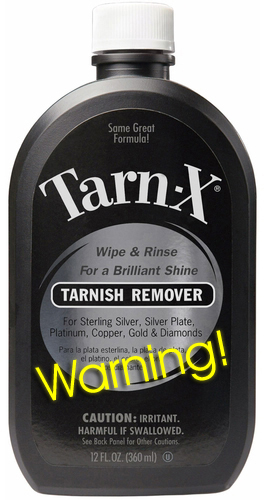
"Warning" about this falsely advertised product. So
thankful to you for preventing my ruining these much cherished pieces
of my Mom's."
•
"Please help! How can I reverse the effects of silver dip? I
placed a sterling silver 925 necklace for a few seconds in a dip. Now
the necklace lacks luster or shine that it had before the dip. It
looks like a dull white coat has covered the necklace. The black
shadows that gave the pendant dimension is now gray."
•
"I wish I had read your comments on this stuff before I ruined
my expensive Pandora Charms! What in the world can be done to reverse
the damage? I was dipping, rinsing, drying and right before my eyes
they started turning white and chalky. Some of them have black spots
too. I am so sad over this as these charms are many years of
collecting. Please help me if you can. Also I don't know how to
dispose of this stuff, I don't want to take chance of some poor
animal coming in contact with it. Please contact me ASAP if you
can be of any help."
•
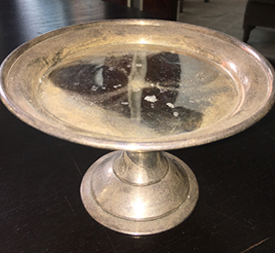
"I stumbled on your website when I had a disaster cleaning an
inherited silver platter from my grandmother with Tarn-X. I'm
devastated and never dreamed silver cleaner would damage my
object. I so wish I would have done research on Tarn-X before I
cleaned my platter but I never had a problem with it before."
•
"I used Tarn-X on my platinum engagement ring, white gold
diamond ring, and ruby ring. They are both ruined. They look
tarnished (gray discoloration) and the surface feels almost corroded."
•
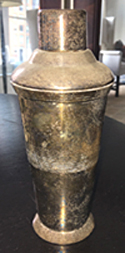
"Needless to say I made a big mistake and used Tarn-X to try to
remove marks left by an item being wrapped tightly for 30 or more
years in Saran Wrap. The handle stills looks like silver but the rest
looks more like brushed aluminum."
•
"I used Tarn-X on my platinum engagement ring and a white gold
diamond and ruby ring. They are both ruined. They look tarnished
(gray discoloration) and the surface feel almost corroded."
The following
number will connect you to your local poison control center: 1-800-222-1222.
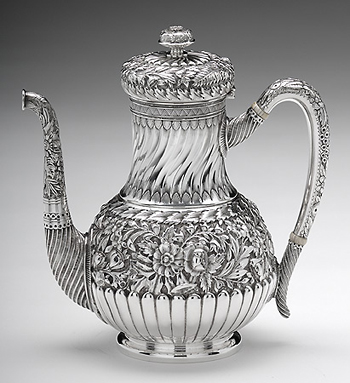
Tarn-X was used on
this coffeepot to remove tarnish, but it also removed removed the
factory-applied patina. The image on the right shows the piece after repatination.
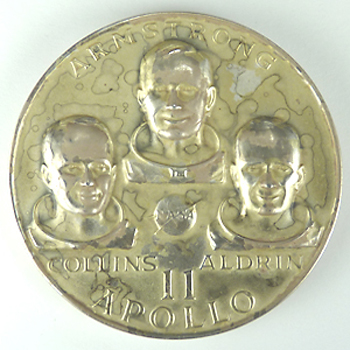
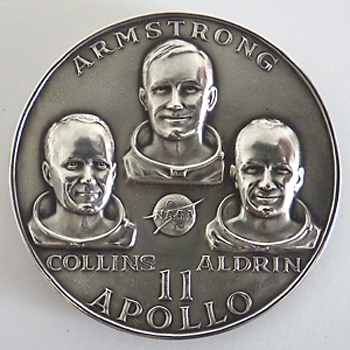
Tarn-X was used to remove the
tarnish that formed underneath this coin's lacquered surface. It also
removed the factory-applied patina! The image on the right shows the
piece after refinishing.
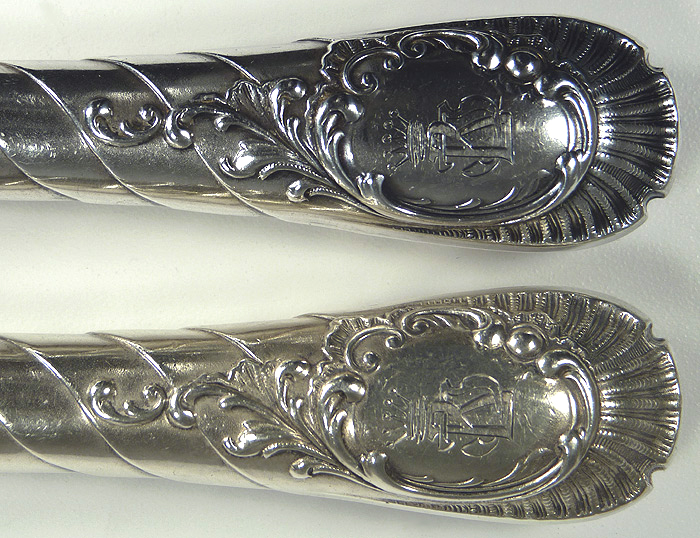
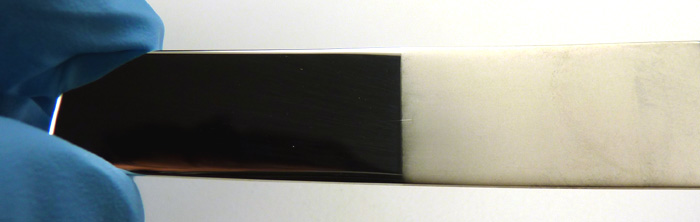
Below are two
knife handles that were tarnished. The top was gently polished with
Earth Friendly Silver Polish, the bottom was left in Tarn-X for
exactly 20 seconds, then neutralized in water with dissolved baking
soda. You can see that virtually all patina was removed from the
bottom handle, leaving a dull, lifeless surface.
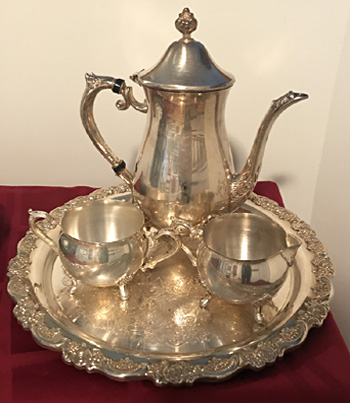
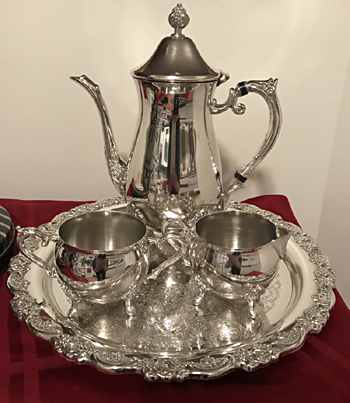
The individual who
owns this coffee set contacted me after using Tarn-X and asked if
there was any way to improve the surface. I recommended Blitz Silver
Shine Polish. When she was finished polishing she was so excited she
sent me the image on the right.
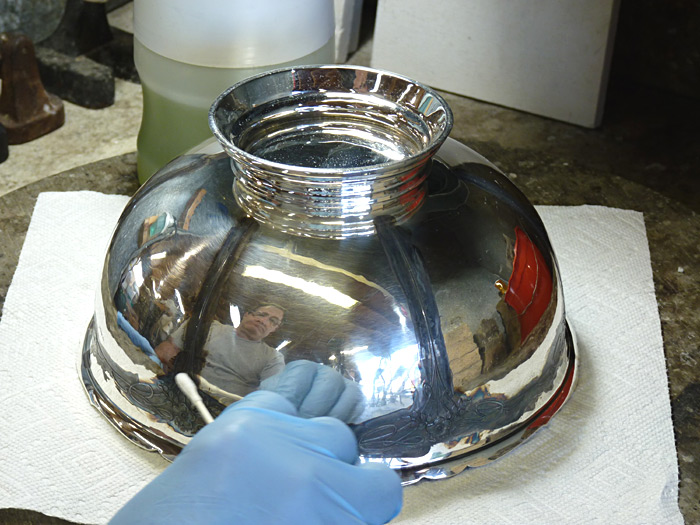
This Arthur Stone
sterling bowl required machine polishing to remove the micro-etching
that resulted from wiping with Tarn-X. I then repatinated the chased
areas and hand polished the entire bowl while highlighting the
delicate chasing.
I have been
testing Tarn-X and other dips for decades while recording the effects
they have on silver. I routinely receive objects for refinishing due
to damage from these horribly destructive products. (I use Tarn-X as
an example because it's used by 95% of the collectors I hear from as
well as its overwhelming market share).
Chemical dips
– in various degrees – quickly strip the shine from silver,
leaving a dull, lifeless appearance.
Chemical dips
quickly remove factory-applied patinas (if left in the solution for
more than a few seconds) or gradually (if dipped quickly each time
the object requires cleaning). You'll notice a soft white surface
develop over a very short period of time.
Chemical dips
damage every silver alloy including .800 (Germany), .900 (coin),
.925, (sterling), .9584 (Britannia silver), and .999 (fine silver).
These dips will also harm copper and gold.
Chemical dips
cause pitting of the object's surface. These surface defects will act
like a sponge and more readily absorb tarnish-producing gases and
moisture. The object will eventually require professional polishing
and possibly repatination to restore the original finish.
MOST chemical dips
are made up of acidified thiourea (a strongly
suspected carcinogen).
Acids are corrosive and will damage silver, niello, bronze,
stainless steel knife blades, and organic materials such as wood and ivory.
Chemical dips,
when used on objects that have sealed components, such as
candlesticks and trophies with hollow feet, or teapots with hollow
handles, may leak into the cavity through small holes or
imperfections in the joints. At this point, it becomes virtually
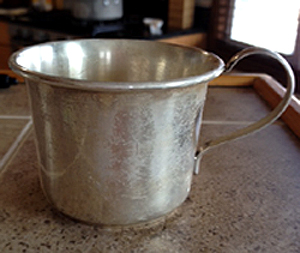
impossible to wash the chemical out. If you're working on a baby cup
with this type of rim, do you really want an infant drinking from it
after using a dip?
Tell your friends
about these dips and recommend they take them to their next household
hazardous waste collection program in their area
Learn the proper
way to remove tarnish by reading The Care of Silver.
Tarn-X
MSDS (Manufacturer's Safety
Data Sheet)
Additional dips
containing acidified thiourea:
Connoisseurs
Silver Jewelry Cleaner
Ellanar Dip
Instant Silver Cleaner
Empire's Instant
Tarnish Remover
Goddard's Silver Dip
Griffith
Insta-Clean Tarnish Remover Dip
Hagerty Flatware Dip
Hagerty Silver Bath
Hagerty Silver Dip
Medallion Care
Tarnish Treatment
Midas Silver Tarnish-Off
ShineBrite Silver Dip
SilverMate
Weiman Instant
Tarnish Remover
Wright's Instant
Tarnish Remover
*
Bring these dips to a household hazardous waste collection site.
Don't dump them down the sink. |